


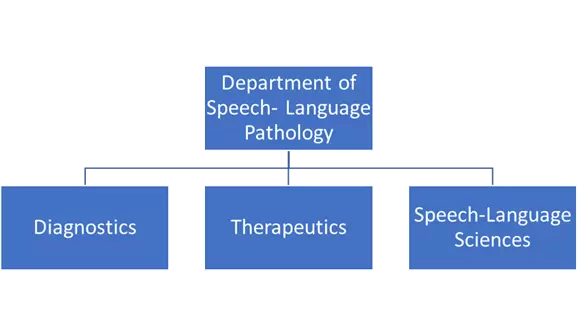
The Department of Speech-Language Pathology is dedicated to the prevention, assessment, diagnosis, and treatment of communication and swallowing disorders across the lifespan, from infants to older adults. We aim to empower individuals by optimizing their ability to speak, understand, read, write, and swallow safely and effectively.
Diagnostics (Assessment & Evaluation)
This category focuses on the comprehensive evaluation of an individual’s communication abilities and swallowing function to accurately identify the presence, nature, and severity of a disorder.
- Core Activities:
- Speech Sound Assessment: Evaluating articulation, phonology, and motor speech disorders (e.g., apraxia, dysarthria).
- Language Evaluation: Assessing Receptive Language (understanding) and Expressive Language (using words/grammar), including social communication (pragmatics).
- Voice and Resonance Analysis: Utilizing instrumentation to assess vocal quality, pitch, loudness, and resonance (e.g., for hoarseness or hypernasality).
- Fluency Assessment: Diagnosing disorders of speech flow, such as stuttering and cluttering.
- Swallowing/Dysphagia Evaluation: Conducting clinical swallow exams to assess feeding and swallowing safety.
- Cognitive-Communication Testing: Evaluating skills like Auditory verbal comprehension, spontaneous speech, repetition skills, Naming, memory, attention, problem-solving, and executive function that impact communication, often following stroke or TBI.
Therapeutics (Intervention & Treatment)
Therapeutics involves the design and implementation of evidence-based intervention plans tailored to each individual’s needs and goals to remediate, improve, or compensate for a disorder.
- Core Services:
- Individual & Group Therapy: Providing direct treatment sessions for speech, language, voice, and fluency disorders.
- Swallowing Rehabilitation: Using exercises, positioning techniques, and diet modification recommendations to improve the safety and efficiency of eating and drinking.
- Augmentative and Alternative Communication (AAC): Assessing and implementing communication systems for individuals who cannot rely on verbal speech, including high-tech devices and low-tech picture boards.
- Aural Rehabilitation: Working with individuals who are deaf or hard of hearing to maximize communication strategies and listening skills.
- Liaison & Counseling: Providing education, resources, and emotional support to patients and their families/caregivers to foster better communication environments.
Speech-Language Sciences: Research & Instrumental Analysis
The Speech-Language Sciences division provides the academic, scientific, and technological backbone for the entire department. Its core mission is to advance the evidence-base of the profession through rigorous research, state-of-the-art instrumental analysis, and the training of future clinicians and researchers.
Instrumental Analysis & Diagnostics Training
This area focuses on teaching students and conducting research using specialized high-tech equipment for the objective, quantifiable analysis of speech, voice, and swallowing functions.
Aerodynamic Analysis:
Spirometers: Devices used to measure lung volume and capacity, providing objective data on respiratory support for speech production. This is essential for evaluating motor speech disorders (dysarthria) and voice disorders. 


Acoustic Analysis Tools:
PRAAT: A powerful, free software program used for the detailed acoustic analysis of speech. It allows for the measurement of fundamental frequency (F0), intensity, and spectral characteristics, which are crucial for analyzing voice disorders, articulation, and prosody.
Sona-Speech : Clinical instrumentation that provides real-time visual feedback (biofeedback) on speech production. This is invaluable for teaching and therapy across various disorders, including articulation, voice, and fluency.
