MVM College of Allied Health Sciences
Laboratories & Library
The teaching laboratories and library of MVM College of Allied Health Sciences, Bengaluru: anatomy and physiology, microbiology, biochemistry, pathology and simulation labs.
Students of MVM College of Allied Health Sciences learn in five teaching laboratories and a library, where theory is turned into hands-on practice.
Anatomy and Physiology Lab
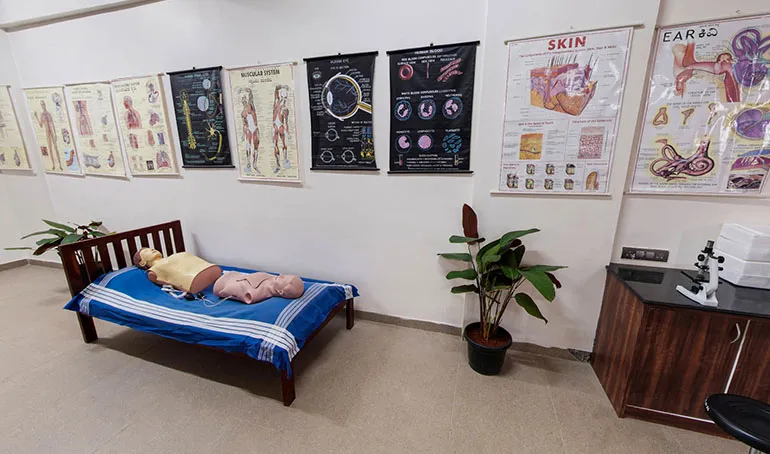
The Anatomy and Physiology laboratory is designed to complement teaching by offering hands-on experience with the structure and function of the human body. Through observation, dissection, and experimentation, you will develop a deeper understanding of the complex systems that support life
Equipment
- Anatomical Models: Detailed replicas of human organs and body parts for visual learning.
- Dissection Tools: Instruments like scalpels, scissors, and forceps for cadaver dissections.
- Human Skeleton Models: Showing the bones of the human body for study and reference.
- Microscopes: For studying tissues, cells, and histology.
- Physiological Measurement Devices: Such as blood pressure cuffs, stethoscopes, and thermometers.
- Electrocardiogram (ECG) Machines: For recording the electrical activity of the heart.
- Spirometers: Measure lung capacity and airflow.
- Human Torso Models: Detailed representations of the human torso for in-depth study.
- Charts and Posters: Illustrations of anatomical structures and physiological processes.
- Preserved Specimens: Preserved organs and tissues for hands-on study.
Experiments and Activities
- Cadaver Dissections: Studying the human body's internal structures through dissections.
- Histology: Examining tissues under microscopes to understand their cellular composition.
- Physiological Measurements: Learning to measure vital signs like blood pressure, heart rate, and respiratory rate.
- Muscle and Nerve Conduction Studies: Understanding how muscles and nerves work together.
- Cardiovascular Experiments: Studying heart function, blood flow, and ECG interpretation.
- Respiratory System Experiments: Investigating lung capacity, oxygen exchange, and respiratory diseases.
- Digestive System Studies: Understanding digestion, absorption, and metabolism processes.
- Neurological Experiments: Exploring the nervous system's functions, reflexes, and sensory perception.
- Endocrine System Studies: Understanding hormone functions and regulation.
- Reproductive System Experiments: Studying human reproduction and embryonic development.
Integration with Curriculum
- Hands-on Learning: Anatomy and Physiology labs provide practical application of theoretical knowledge from lectures.
- Clinical Relevance: Linking lab exercises to real-world clinical scenarios to enhance understanding.
- Preparation for Healthcare Professions: Essential for students pursuing careers in nursing, physical therapy, medical technology, and other allied health fields.
- Research Opportunities: Labs can serve as a foundation for student research projects related to human biology and health.
Anatomy and Physiology labs play a crucial role in the education of allied health science students, providing them with the essential skills and knowledge required for their future roles in healthcare and medical research.
Microbiology Lab
This lab course is designed to introduce students to the world of microorganisms—organisms too small to be seen without a microscope but essential to life, health, and disease. Students learn to safely observe, culture, identify, and understand microbes through hands-on experiments that support your understanding of microbiological theory.
Here's an overview of Microbiology lab
Equipment
- Anatomical Models: Detailed replicas of human organs and body parts for visual learning.
- Microscopes: Essential for studying microorganisms, including bacteria, viruses, and fungi.
- Incubators: Provides controlled temperature for the cultivation and growth of microorganisms.
- Autoclaves: Sterilises equipment and media using high-pressure steam.
- Biosafety Cabinets: Provides a sterile environment for handling pathogenic microorganisms.
- Centrifuges: Separates components of microbial cultures for analysis.
- PCR Machines: Used for DNA amplification, crucial for genetic studies of microorganisms.
- Agar Plates, Petri Dishes, and Culture Tubes: Containers for culturing microorganisms.
- Microbial Inoculation Loop: Used to transfer microorganisms to agar plates for culturing.
- Vortex Mixer: Mixes small vials of liquids, commonly used in microbial assays.
- Refrigerators and Freezers: Stores microbial cultures, reagents, and samples at specific temperatures.
- pH Meters and Incubators: Maintains specific pH levels for microbial cultures.
- Staining Kits: Used for staining microorganisms to improve visibility under the microscope.
Integration with Curriculum
- Hands-on Learning: Lab sessions provide practical application of theoretical knowledge.
- Diagnostic Skills: Students learn skills crucial for clinical diagnostics and research.
- Research Opportunities: Engaging students in research projects related to microbiology.
- Interdisciplinary Learning: Collaborating with other health sciences for comprehensive understanding of healthcare-associated infections.
A well-equipped and properly maintained microbiology lab is vital for students in allied health sciences, providing them with the practical skills and knowledge needed for careers in healthcare, research, and public health.
Biochemistry Lab
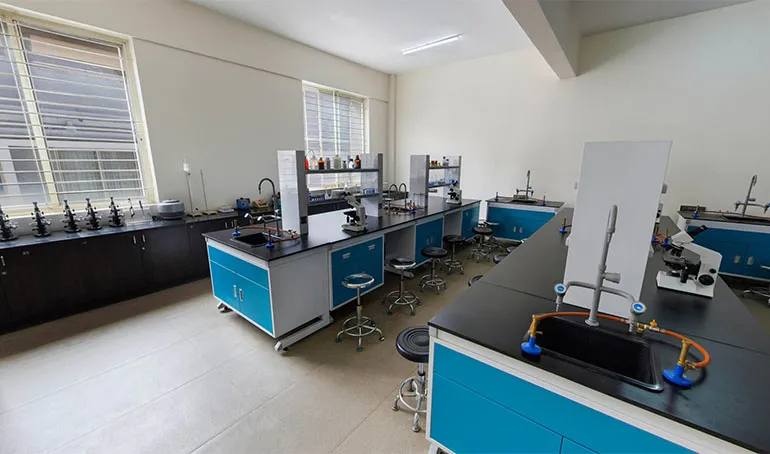
This lab is an essential part of biochemistry education, where theoretical concepts are brought to life through practical experimentation. Students gain hands-on experience with biochemical techniques that are fundamental to understanding molecular biology, metabolism, and clinical diagnostics.
Equipment
- Microscopes: Essential for studying cellular structures and microorganisms.
- Centrifuges: Used to separate components of blood and other substances.
- Spectrophotometers: For quantitative analysis of substances in various biological samples.
- pH Meters: Measure the acidity or alkalinity of a solution.
- Electrophoresis Equipment: Used for separating DNA, RNA or proteins based on their size and charge.
- Incubators: Provide a controlled environment for the cultivation of microorganisms or cells.
- Autoclaves: Sterilise equipment and media using high-pressure steam.
- Gel Documentation System: Captures and documents images of DNA or protein gels.
- Analytical Balances: Measure mass with high precision, crucial for preparing solutions.
- Water Baths: Maintain a constant temperature for incubation and inactivation reactions.
- Safety Cabinets: Ensure a sterile and safe environment for handling biological samples.
- Refrigerators and Freezers: Store reagents, samples and cultures at specific temperatures.
- Laboratory Glassware: Pipettes, test tubes, flasks and Petri dishes for various experiments.
Safety protocols
- Lab Coats & Gloves: Standard lab attire to protect against spills and splashes.
- Proper Disposal: Guidelines for disposing of biological and chemical waste safely.
- Emergency Procedures: Protocols for handling spills, fires, or injuries.
- Ventilation: Adequate ventilation to remove fumes and ensure a safe working environment.
- Labelling and Storage: Properly labelling chemicals and storing them according to compatibility.
Integration with Curriculum
- Experiential Learning: Lab sessions complement theoretical coursework, enhancing understanding.
- Research Opportunities: Students might engage in research projects under faculty guidance.
- Skill Development: Hands-on experience improves practical skills, essential for future careers.
- Interdisciplinary Learning: Labs might collaborate with other healthcare disciplines for comprehensive learning experiences.
A well-equipped and well-maintained biochemistry lab is indispensable for students in allied health sciences, providing them with the practical skills and knowledge necessary for their future roles in healthcare.
Pathology Lab
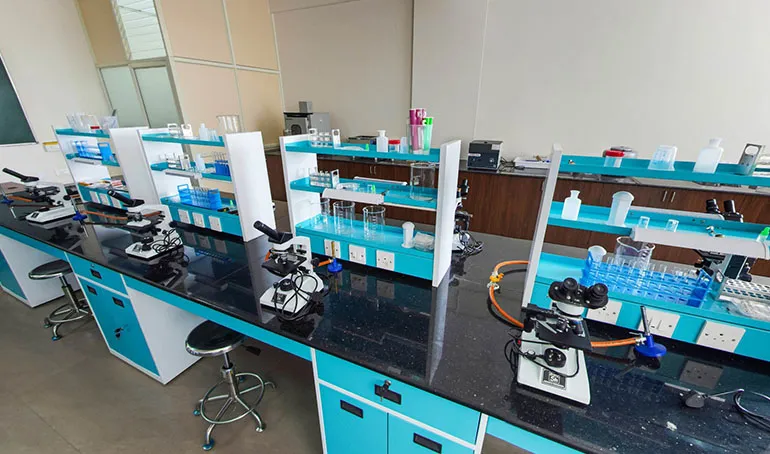
This lab plays a crucial role in understanding disease processes at the cellular and tissue levels. It is designed to provide hands-on experience with the tools and techniques used to diagnose diseases, correlate clinical symptoms with histological changes, and understand the underlying mechanisms of various pathological conditions.
Equipment
- Microscopes: Used for examining tissue samples, blood smears, and other specimens at a cellular level.
- Histology Slides: Prepared slides for studying the microscopic structure of tissues.
- Cytology Equipment: Including slides and stains for the examination of cells.
- Automated Analysers: For blood tests, including complete blood counts (CBC), blood chemistry, and coagulation studies.
- Immunohistochemistry (IHC) Kits: Used to detect specific antigens in tissue samples.
- Molecular Pathology Equipment: For DNA, RNA, and protein analysis, including PCR machines and DNA sequencers.
- Biopsy Instruments: Including needles and forceps for collecting tissue samples.
- Tissue Culture Facilities: For growing cells and studying diseases at a cellular level.
- Autopsy Tools: Instruments for post-mortem examinations.
Integration with Curriculum
- Diagnostic Skills: Teaching students how to analyse samples and diagnose diseases accurately.
- Interpretation of Results: Training students to understand and interpret lab results for patient diagnosis and treatment.
- Research Opportunities: Providing students with the opportunity to conduct research on various diseases.
- Clinical Experience: Allowing students to gain practical experience in a controlled environment, preparing them for real-world scenarios.
A well-equipped and well-maintained pathology lab is essential for students in allied health sciences, providing them with the practical skills and knowledge needed for careers in clinical laboratories, research institutions, and healthcare settings.
Simulation Lab
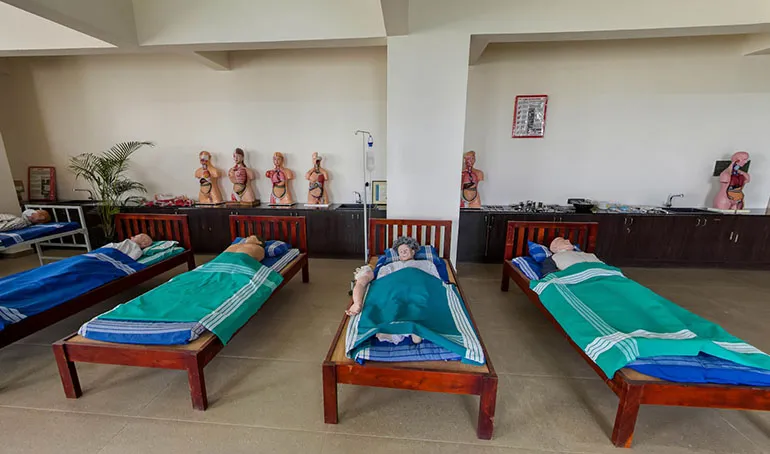
The college has a dedicated simulation lab for practising clinical skills.
Library

The library houses a diverse and extensive collection of academic resources, including textbooks, reference books, scholarly journals, research papers, e-books, audiobooks, and more. The collection covers a wide range of subjects and caters to the curriculum and research interests of the college.
Begin your journey at Allied Health Sciences
Admissions are open. Talk to our admissions team or apply online today.